Showing posts with label AMD processor. Show all posts

Wednesday, December 14, 2016

AMD Zen Is Now Called Ryzen, Challenges Intel with Desktop CPUs Clocked at 3.4GHz+ Coming Q1 2017


AMD's new Zen micro-architecture has been a long time coming. We've had a few glimpses of what to expect over the past six months, but at the recent AMD Tech Summit last week, AMD finally revealed the official name for the new processor: Ryzen. It is pronounced ‘Rye-zen’, not ‘Riz-zen’, to clarify.

At the New Horizon event in Austin, Texas on Tuesday, AMD shared these details with the general public. Here's everything we know so far about AMD's upcoming CPUs.

For starters, the Zen CPU architecture will come to market carrying the name Ryzen, with the first set of "Summit Ridge" desktop CPUs now expected to ship in Q1 2017. Ryzen will be the finale of a four-year effort by AMD to regain the market share it has lost to Intel in the high-performance desktop market.


Jim Anderson, Senior Vice President and GM, Computing and Graphics, believes that with PC gaming hardware sales growing thanks to VR and other use cases, the "market is right for powerful new desktop processors" and AMD, of course, believes that Ryzen is the answer.

Ryzen desktop CPUs will be based on the new AMD AM4 platform, will have 8 cores (16 threads) clocked at 3.4GHz+ and 4MB of L2 cache as well as 16MB of L3 cache. Details on the AM4 platform are scant except for the fact that it supports DDR4, PCIe Gen. 3, USB 3.1 Gen. 2, NVMe, and SATA Express technologies.


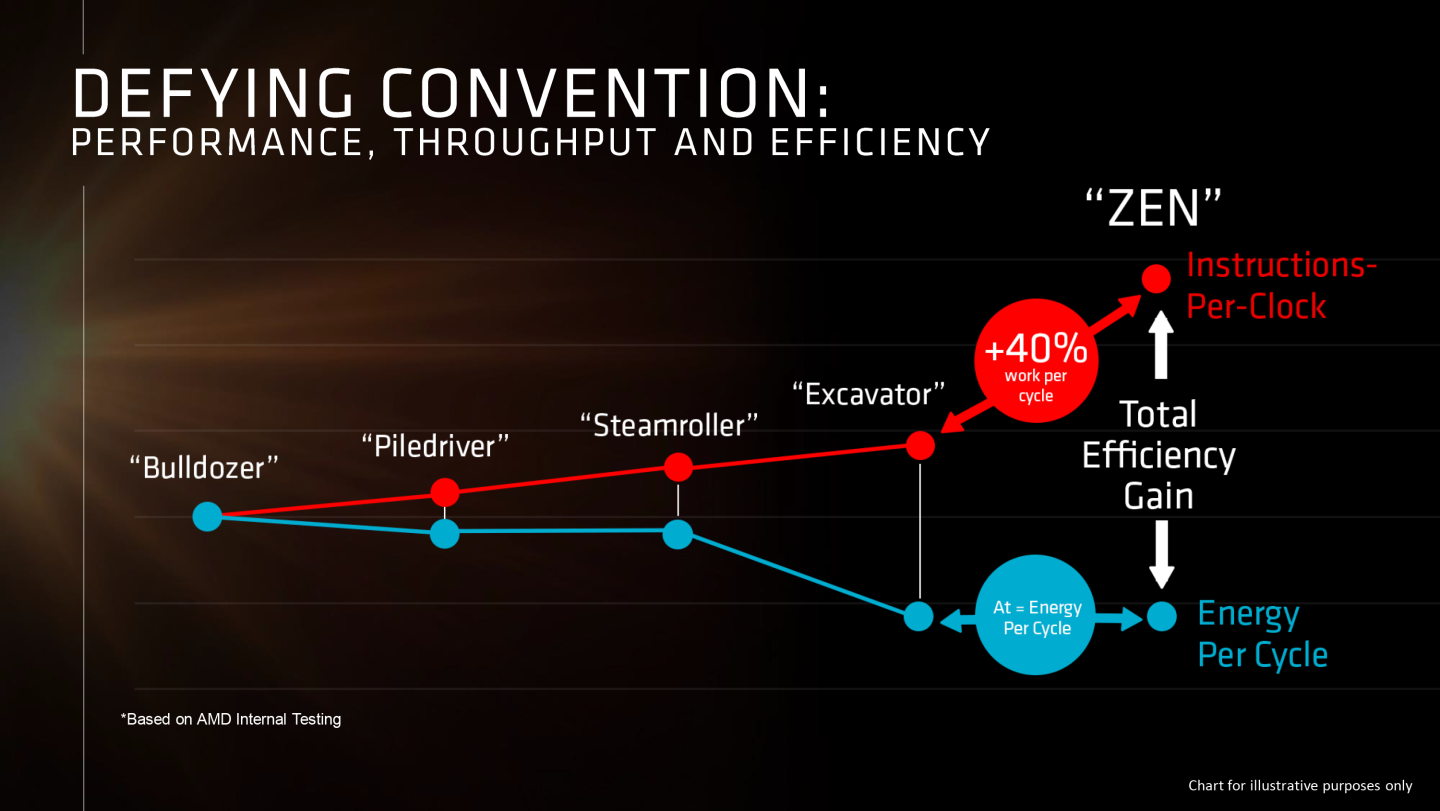
AMD's demos showed the Ryzen CPU using less power, with the company claiming it is on track to achieve its earlier claims of 40 percent more instructions per clock using the same amount of energy.

The performance gains and the efficient energy use are attributed in part to the new AMD SenseMI technology. The five key features of this are - Pure Power, Precision Boost, Extended Frequency Range, Neural Net Prediction, and Smart Prefetch.

Starting with Pure Power, at the heart of the CPU are a set of embedded sensors which allow for monitoring of temperature, speed, and voltage in real time. Coupled with Infinity Fabric, they allow for greater power efficiency than before. While AMD was silent of the inner workings of Infinity Fabric, we do know that it’s a protocol that makes this kind of monitoring, and other communication, within the SoC possible.


Precision Boost allows for fine-grained frequency control, which means instead of the CPU operating at non-turbo and a higher frequency turbo speeds, it can now increase (or presumably, decrease) the frequency in 25MHz increments, allowing for greater power efficiency.


Extended Frequency Range will please enthusiasts as it permits frequencies above and beyond ordinary Precision Boost limits, with exact clock speeds scaling with the cooling solution used. Best of all, it will be fully automated with no user intervention required.


Neural Net Prediction will let the CPU anticipate future decisions, preload instructions, and choose the best path through the CPU, further increasing overall efficiency.


Smart Prefetch will let Ryzen CPUs anticipate the location of future data accesses by application code and then prefetch vital data into a local cache so it’s ready for immediate use.


As stated earlier, the desktop-grade "Summit Ridge" AMD Ryzen CPUs will ship in Q1 2017, with "Naples" chips for servers due to arrive in Q2 2017. "Raven Ridge" chips suitable for use in notebooks will be available in the second half of next year. AMD President and CEO Dr Lisa Su believes Ryzen will give AMD the "best product stack we've had in a decade", and it’s safe to say the company has a lot riding on it.


Source: AMD
Follow Me on Twitter>>>> @iamBhavish
And like us on Facebook>>> The Gud1

Thursday, August 18, 2016

AMD Promises to Return to High-Performance CPU Market With New 'Zen' Architecture


AMD's long-awaited Zen micro-architecture is finally ready to be shown off to the world, and the company held a small event in San Francisco on Wednesday, timed deliberately to coincide with the Intel Developer Forum. AMD CEO Lisa Su and CTO Mark Papermaster shared a few concrete details about the Zen architecture, although no specific CPU models were unveiled. It was also announced that products would not ship before the end of this year as earlier expected.

Zen is a completely new architecture, which the company has been working on in the hopes of reclaiming market share lost by its current lineup of FX-series CPUs and A-series APUs, most of which have been underwhelming. AMD has been unable to match Intel at the high end of the performance scale for several years now and has had to cut prices drastically in order to remain an option at the low end. Also, while AMD has not progressed beyond the 28nm fabrication process, Intel has been able to go down to 14nm and was till recently expected to achieve 10nm fabrication this year. The stakes for AMD therefore cannot be overstated.

AMD pointed out its successes in the games console market, including the fact that Microsoft will use an AMD processor in its upcoming Xbox One 'Project Scorpio' refresh, as well as the positive reception its new Radeon RX-series graphics cards have had. CEO Lisa Su described the company's current and upcoming offerings as its "most competitive product lineup in a decade". Overall, AMD is claiming that Zen offers 40 percent more performance per clock cycle than its current products.


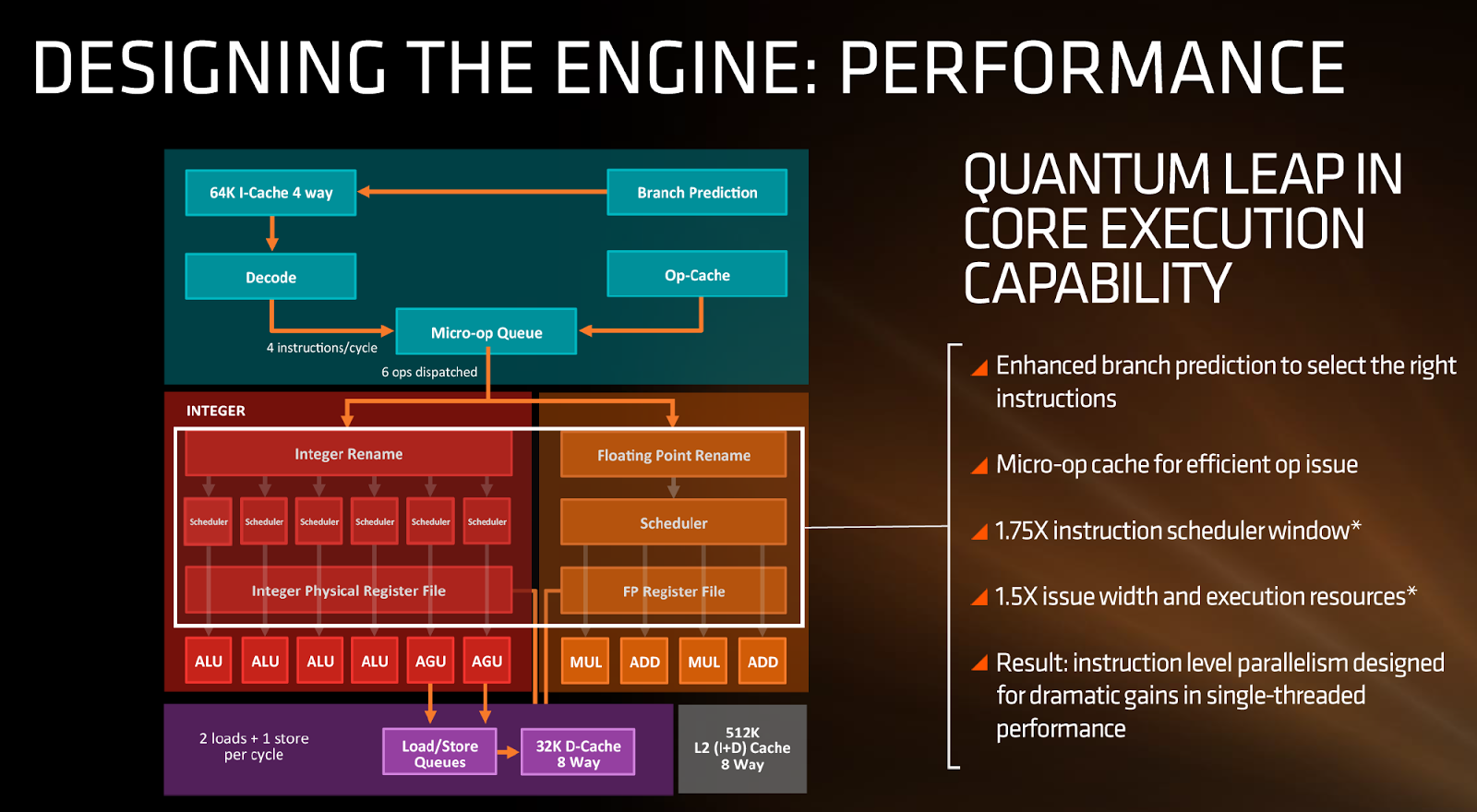
Zen will introduce a number of new techniques and features, starting with a new pipeline with improved branch prediction and a new micro-op cache resulting in improved efficiency in terms of instructions per clock cycle. A typical Zen CPU will have 8MB of shared L3 cache, while each core will have a 512K L2 cache as well as independent L1 caches for data and instructions. The result should be up to 5X better cache bandwidth to a core. AMD is no longer sharing resources between cores, which enables it to offer simultaneous multi-threading more like Intel's Hyper-Threading technique. Each core can execute two threads, both of which appear equal to the OS and software.

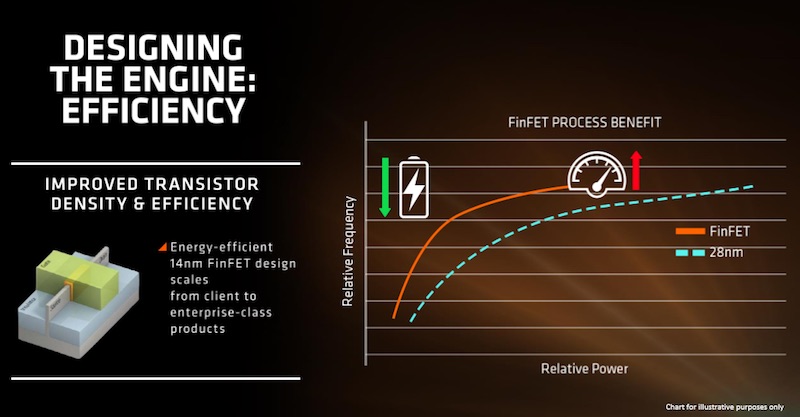
Zen CPUs will be fabricated by GlobalFoundries on a 14nm 3D FinFET process which should have a significantly positive impact on heat generation and power consumption, allowing AMD to push into thin and light notebooks which have been powered by Intel for years now. Power efficiency has also factored into the design of the architecture, and different blocks will be able to have their power reduced or turned off when they aren't needed.

While exact product SKUs, speeds, TDPs, core counts and of course prices were not shared, we do know what form at least some of them will take. The company is using the code name 'Summit Ridge' for at least one 8-core, 16-thread CPU which will be aimed at high-end enthusiasts and gamers. AMD compared a Summit Ridge engineering sample to Intel's top-of-the-line 8-core Broadwell-E Core i7-6900K Extreme Edition CPU at its event, though that particular sample was down-clocked to match the Summit Ridge at 3GHz. The company is claiming equivalent or better performance between architectures, though only one very specific Blender 3D workload was compared.


Desktop Zen CPus like the Summit Ridge will require new motherboards and chipsets, which AMD is delivering in the form of the Socket AM4 platform. This is another area in which AMD has lagged, but AM4 will correct that with support for modern IO including PCIe 3.0, NVMe, DDR4 RAM, and 10Gbps USB 3.1.

There will also be a server SoC product, codenamed 'Naples', with 32 cores, which will be capable of running in multi-socket configurations. While the mobile and embedded markets were mentioned, no specific products were named. We'll have to wait for more information, though at least some new details could be released as early as next week when AMD presents its Zen architecture at the annual Hot Chips conference.


While a resurgent AMD would be great for consumers and for the industry as a whole, there isn't enough information yet to be able to guess how successful Zen might be. The comparison to Intel's latest and greatest architecture is a positive sign, even with only one demonstration in a very specific test with parameters and conditions chosen by AMD itself.


Do Check out AMD's Massive Rebellion Giveaway!


Also don't forget to Subscribe!
And Follow Me on Twitter>>> @iamBhavish
As well as like us on Facebook>>> The Gud1